
Germany, 1923: when the mark stopped measuring
In 1923, German prices changed so quickly that wages could be paid each day and spent immediately. The mark stopped serving as a stable reference for contracts, savings, and everyday purchases.
The image of wheelbarrows full of banknotes is real, but it does not explain the crisis by itself. Hyperinflation resulted from years of war, debt, deficits, lost production, international conflict, and money creation.
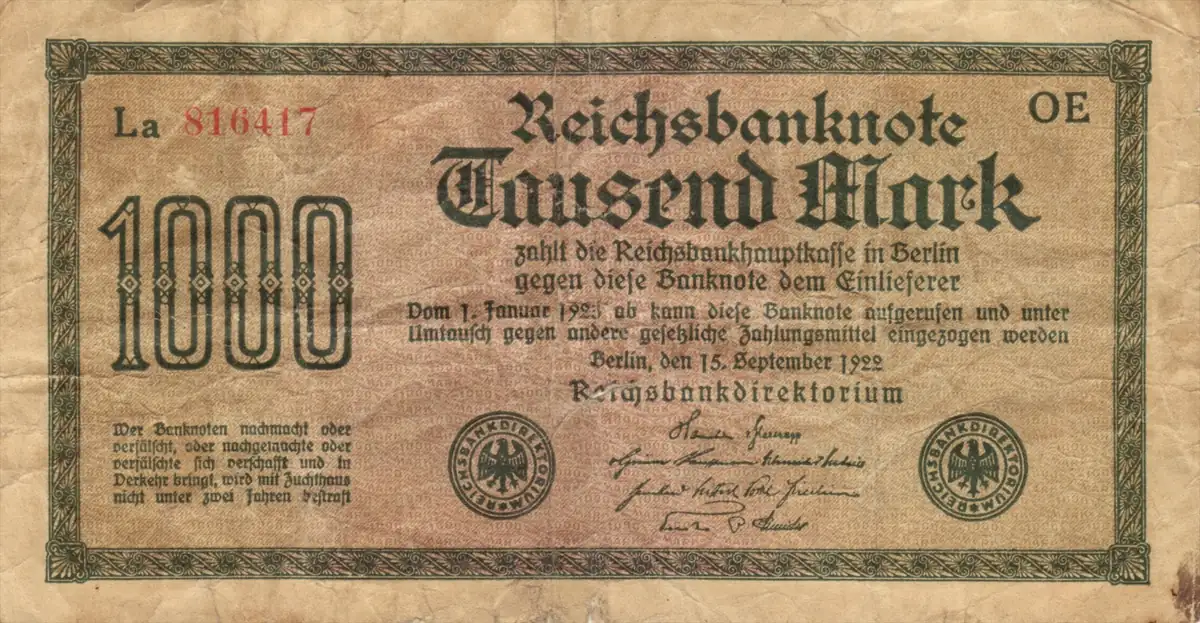
The starting point: World War I
Germany suspended mark convertibility into gold in 1914. The government financed much of the war through debt, expecting victory to help cover the costs.
The war ended in defeat, a damaged economy, and large financial obligations. The Treaty of Versailles imposed reparations whose amount and payment method remained disputed.
The public budget continued to run deficits. The central bank supported their financing through money creation.
Inflation before hyperinflation
Prices and the exchange rate had already deteriorated before 1923. The currency lost value against foreign currencies, and people tried to protect themselves by buying goods, assets, or foreign money.
This behavior increased money velocity because no one wanted to hold marks for long.
Inflation became hyperinflation when price increases and lost confidence began reinforcing each other at great speed.
The occupation of the Ruhr
French and Belgian troops occupied the industrial Ruhr region in January 1923 after failures to deliver reparations.
The German government responded with passive resistance. Workers and businesses reduced or stopped cooperation with the occupying authorities.
The state continued paying wages and support while production and tax revenue fell. Much of the spending was financed by creating money.
Pressure on the mark became extreme.
Prices that lost meaning
The Bundesbank describes merchants updating prices continuously and workers spending wages as soon as they received them.
In November 1923, one U.S. dollar reached about 4.2 trillion paper marks.
Banknotes accumulated zeros. A denomination could lose usefulness between its order and entry into circulation.
The problem was not a lack of large numbers. The unit could no longer measure value consistently.
Who lost and who could protect themselves
Hyperinflation destroyed much of the real value of:
- Cash.
- Nominal bank savings.
- Fixed pensions.
- Bonds and loans denominated in marks.
Some debtors benefited because they repaid obligations with depreciated money. Owners of real assets, foreign currency, or tradable goods could protect themselves better, although outcomes varied.
The crisis redistributed wealth unpredictably and damaged trust in contracts and institutions.
Stabilization
Passive resistance ended in September 1923. The government adopted fiscal measures and stopped financing some extraordinary spending.
The Rentenmark was introduced in November. It was not convertible into gold, but issuance was limited and presented as backed by claims on land and industrial assets.
The scale relationship used for stabilization was:
1 Rentenmark = 1,000,000,000,000 paper marks
The exchange rate stabilized. The Reichsmark became the permanent legal currency under the new monetary framework in 1924.
The new unit helped, but stabilization also depended on fiscal adjustment, international credit, and restored confidence.
What the episode teaches
Hyperinflation does not end simply by printing banknotes with fewer zeros. People must believe that the money supply and public finances will follow sustainable rules.
The episode also shows how high inflation damages money's unit-of-account function. When a figure becomes outdated within hours, price comparison becomes difficult.